
In This Story
If you’ve ever run a discount to spike sales — and then felt that quiet panic when you checked your margins — you’re not alone. Discounts are easy. They work fast. But over time, they train your customers to wait for the next promo rather than buy at full price.
A well-structured free gift with purchase (above a spending threshold) does something smarter. It doesn’t lower your product’s value — it increases the perceived value of the order. That subtle shift changes how customers behave in your cart.
The Real Problem Isn’t Price. It’s Cart Hesitation.

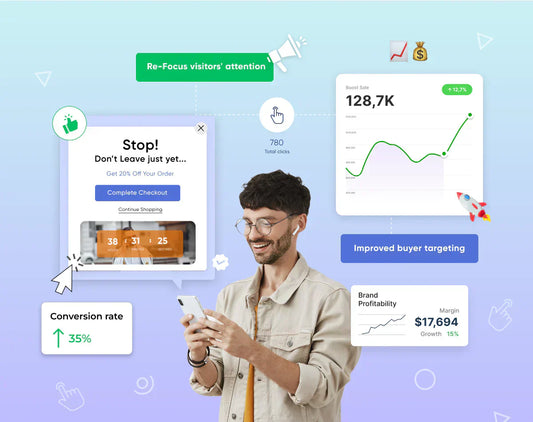
Most shoppers don’t abandon their cart because your product is bad. They hesitate. They add items, get to checkout, and suddenly start second-guessing everything. “Do I really need all this?” “Maybe I’ll come back later.”
That moment of doubt is where revenue quietly disappears. A threshold-based free gift interrupts that hesitation. It gives customers a reason to move forward instead of backward.
When someone sees, “Spend $99 and get a FREE travel kit worth $29,” the mental math changes. If their cart is at $82, they’re not asking what to remove—they’re asking what to add. That’s a completely different buying mindset.
Why Above-Threshold Gifts Increase AOV

This strategy works because it taps into how people respond to goals. When customers see a clear target — especially one that feels close — they feel motivated to complete it. A simple message like, “You’re $17 away from your FREE gift,” creates forward momentum.
Instead of shrinking their cart, shoppers look for ways to build it. That’s the shift you want.
It activates powerful behavioral triggers:
- The goal gradient effect (we push harder when we’re close to finishing)
- Loss aversion (we hate missing out on something we almost had)
- Value stacking (getting more feels better than paying less)
And here’s the key insight: it’s not really about the free item. It’s about the finish line.
Setting the Right Spending Threshold

Your threshold can’t be random. If your Average Order Value (AOV) is $60 and you set the gift at $65, you won’t meaningfully change behavior. The gap is too small — most customers will hit it anyway, and you’ll just erode margin.
Instead, your threshold should sit roughly 20–35% above your current AOV. That range feels achievable but not automatic.
For example:
- AOV $60 → Threshold $75–$85
- AOV $120 → Threshold $149
- AOV $200 → Threshold $249–$269
Too high, and customers ignore it. Too low, and you’re giving away profit without driving incremental revenue. The sweet spot feels like a stretch — but a realistic one.
Choosing a Gift That Actually Converts

Here’s the hard truth: if the gift is boring, this strategy falls flat. The best-performing free gifts are highly relevant to what customers are already buying. Relevance drives usefulness, and usefulness drives action.
If you sell skincare, offer a mini serum or cleanser. If you sell supplements, include a branded shaker or travel pack. If you’re in apparel, think limited-edition accessories or add-ons that complement the core purchase.
Trial-sized premium products work especially well for American DTC brands. They feel exclusive and introduce customers to higher-ticket items they may purchase later. In that case, the gift isn’t just boosting AOV — it’s seeding future revenue.
Also, prioritize high perceived value over high production cost. A product that feels worth $29 but costs you $6 to produce is far more strategic than offering a flat 10% discount. Perception drives behavior — not math.
Where to Display the Offer for Maximum Impact

If shoppers don’t see the threshold early, they won’t build their cart around it. The product page should clearly communicate the reward. A visible message like, “Spend $99+ and get a FREE Hydration Kit ($29 value),” plants the idea before they even add to cart.
On platforms like Shopify, announcement bars and cart extensions make it easy to show consistent threshold messaging across the site. But the cart page is where this strategy really performs.
A dynamic progress message — “You’re $14 away from unlocking your FREE $29 gift” — creates clarity and urgency. Once the threshold is reached, the gift should be auto-added. Friction kills momentum. The reward should feel instant.
If you’re using post-purchase tools like ReConvert, you can even layer additional offers after checkout to compound order value without touching your core pricing.
The Bigger Picture: Incentive Design Over Discounting

Free gifts aren’t giveaways. They’re behavioral design tools.
When structured correctly, they:
- Increase AOV
- Reduce checkout hesitation
- Protect brand positioning
- Improve perceived generosity
- Encourage cart optimization
Discounts teach customers to expect lower prices. Strategic gifting teaches them to expect more value. And in American DTC ecommerce, the brands that grow sustainably aren’t the cheapest — they’re the ones that design smarter buying experiences.